How to Use Construction Progress Photos That Actually Prove Work
How to take and organize construction progress photos in Nepal so they prove work done, support payments and keep NRN clients informed — not just fill a WhatsApp gallery.
GharNaksa Team
Construction tracking for Nepal
Progress photos are the cheapest insurance on a construction site — when they are taken with intent. A random gallery of walls does not answer “was the slab steel placed before concrete?” or “was waterproofing done before tiling?” Dated, labeled photos do.
This guide is a field checklist for homeowners, supervisors and NRN clients. Combine it with a daily site log and, when you need independent eyes on site, remote construction monitoring.
What a useful progress photo must include
- Date context — phone date stamps help; storing photos against a dated log is better.
- Location on the building — ground floor lobby, first-floor bedroom wet wall, terrace parapet.
- Work stage — formwork, steel, concrete pour, brickwork, plaster, waterproofing, tiling.
- Wide + detail pair — one wide shot for context, one close shot for quality (joints, cover, membrane laps).
- Reference object when scale matters — tape, rebar mark or doorway so thickness and spacing are readable.
Stage-by-stage photo checklist
- 1Excavation & foundation — depth, soil, PCC, reinforcement, pour day.
- 2Columns, beams, slabs — steel placement, cover blocks, pour, curing.
- 3Brickwork / blockwork — openings, alignment, mortar consistency samples.
- 4Services rough-in — plumbing lines, electrical conduits before plaster.
- 5Waterproofing — membrane or coating applied; flood test when done.
- 6Finishing — tile falls, paint coats, fixture install, snags.
- 7Materials on arrival — brand labels on cement, steel, waterproofing and tile boxes.
Material arrival photos also feed expense tracking — see track cement, rod and sand and construction expenses.
How remote owners should review photos
- Ask for the same camera angles each week so change is visible.
- Request the hidden-stage shots listed above, not only pretty elevations.
- Match photos to the payment milestone before releasing money (payment schedule guide).
- Keep questions in the project record so decisions are searchable later.
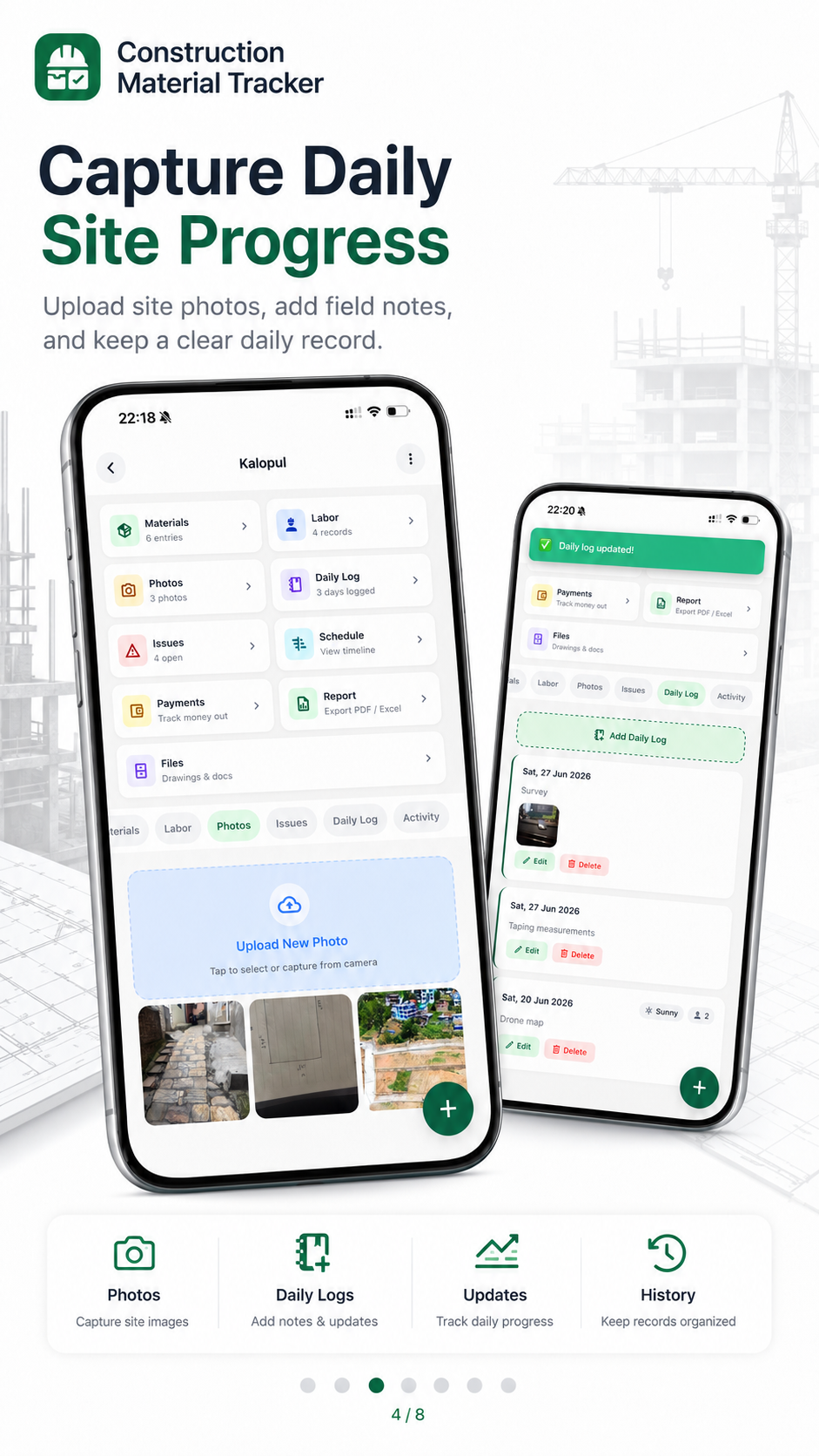
Chat apps bury evidence. A construction tracker that stores photos with the project — the model explained in construction tracker app for Nepal — keeps proof aligned with materials and payments.
Common photo mistakes
- Only exterior shots while critical interior stages go unrecorded.
- No night or early-morning pour photos when night work happened.
- Heavy filters or compression that hide cracks and honeycombing.
- Hundreds of near-duplicate images with zero labels.
- Photos taken after a dispute starts — too late to prove the original condition.
Make photos part of the payment culture
Agree at kickoff: stage payments require the photo set for that stage plus the material and labor log. That single rule reduces pressure payments and improves trust for NRN-funded builds.
GharNaksa is built for this workflow — daily logs, photos, materials and payments in one shared project, with reports you can send instead of scrolling a chat history.